Maker vs Mover Work
In March 2008, as the financial crisis loomed, author and academic Clay Shirky published a piece about newspapers that went what we’d describe today as “going viral”: “Newspapers and Thinking the Unthinkable”.
The piece argued something that was blasphemous in the moment: newspapers were already dead. The internet disrupted them and it was time, Shirky argued, for the industry to acknowledge this. He writes:
When reality is labeled unthinkable, it creates a kind of sickness in an industry. Leadership becomes faith-based, while employees who have the temerity to suggest that what seems to be happening is in fact happening are herded into Innovation Departments, where they can be ignored en masse. This shunting aside of the realists in favor of the fabulists has different effects on different industries at different times. One of the effects on the newspapers is that many of their most passionate defenders are unable, even now, to plan for a world in which the industry they knew is visibly going away.
In our last issue, we covered how companies should think about the AI age. For this edition, let’s focus on the individual. Let’s focus on you.
And let’s focus on the unthinkable: Your job is going to be unrecognizable soon.
We’re all asking the same questions:
- Is my company’s product at risk of being disrupted?
- Is what I do each day the best use of my time in the age of AI?
- Most importantly, is what I’m doing as an individual in my career even going to be a thing in 5 years?
I’m not going to write about this with the kind of unearned and false authority that seems to do numbers on social media. But I spend each day working with marketing and executive teams and I see some themes:
Make sure you’re a Maker, not a Mover
A Maker is someone who creates something new. A new idea, a new story, a new product.
A Mover is someone who takes what exists and optimizes, reformats, or otherwise adjusts it depending on the context.
The reporter who conducts interviews is the Maker.
The act of taking those interviews and writing them is Mover work.
Repackaging that written article for social is Mover work.
AI will eat all of the “Mover” work by taking the raw ingredients produced by the Makers and brute-force its way to producing its optimal arrangement. For what it lacks in humanity and emotional context, it can make up for in sheer volume.
We’ve seen this kind of disruption before. It used to be someone’s job to meticulously typeset a newspaper or magazine. Then word processors came around. It used to be someone’s job to hand deliver the news to your doorstep. Now we have browsers and email.
All Maker work is not created equal
When I tell people this theory they usually push back right away pointing out that the cost of creation has gone to zero. So why, pray tell, do Makers thrive in the AI age?
To explain, let’s take another AI-level disruption: the creation of the smartphone. When everyone has a professional quality camera in their pocket, one would think that we’d need fewer photographers. It’s easier to make, so Maker work would be first to go, right?
That never happened. The number of photographers has remained flat and, depending on the year, slightly increased. Wages, meanwhile, kept pace with or slightly exceeded inflation 1. The efficiency did not remove demand for Maker work — at least not in terms of employment.
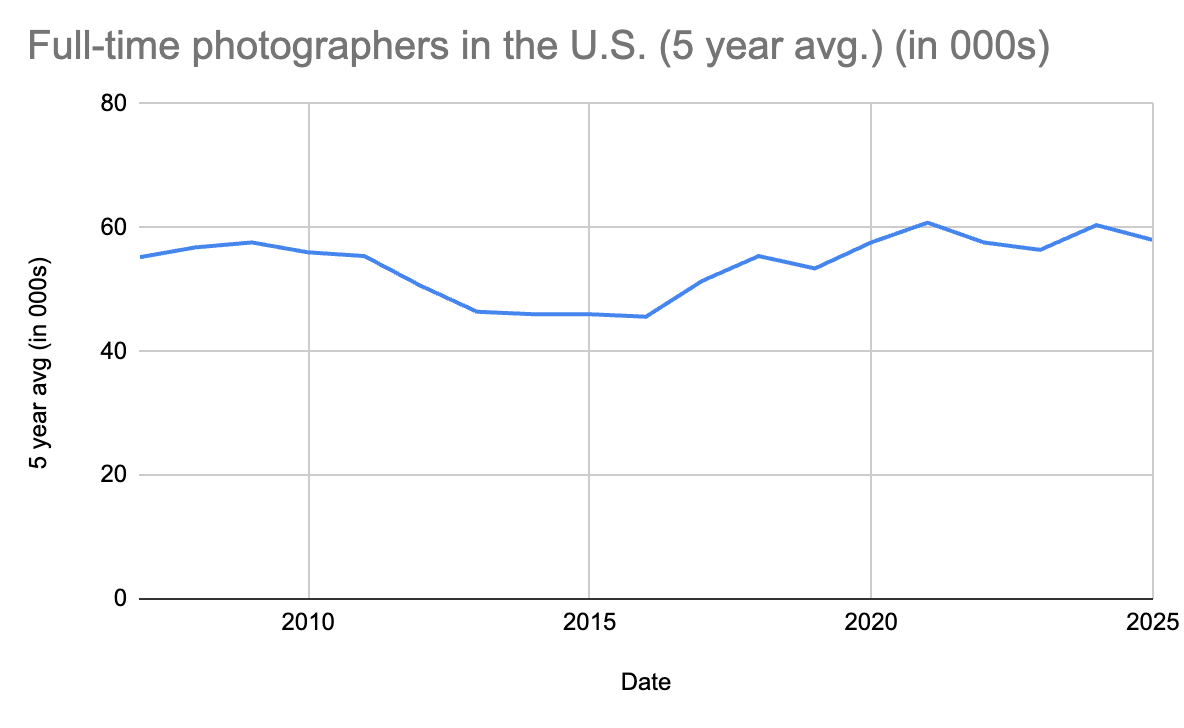
(Btw you can do the same for accountants, Makers in their own right, they held steady in the age of QuickBooks. Same with software engineers in the age of Claude Code.)
So what happened?
A flat line (like the one in the chart above) can appear to reflect the status quo. But a more accurate explanation is that photography jobs that leverage the new tech (in this case, the iPhone, photo editing tools, and the internet) replace the photography jobs that were in the “old world” — think darkrooms and selling news photos for thousands of dollars to profitable media publications.
Yes, Maker work is more durable, but the nature of Maker work changes. To survive, you’ll need to capture the benefits of AI.
Dumb vs smart Maker work
There are people using AI for “Maker” work such as business writing. This is an ineffective use of the tool. It’s dumb Maker work.
Sure, it saves the individual a few minutes or even hours, but unless the user is giving it new and novel inputs, the output will by definition be mediocre. This is ok for, say, smoothing over an important email. Less so for your company’s manifesto. Or your Q2 analysis.
A Feb 22nd article in the Economist highlighted that only 13% of U.S. working-age adults use AI every day. And the ones that do mostly use it for “discrete tasks,” not fancy automations or workflows. The same article notes that we haven’t seen macroeconomic productivity gains from AI usage yet.
I often see busy executives just throw AI vomit at their teams and expect them to use it productively. Or I see marketers take a brief and generate a blog post, shrug, and then hit publish. More dumb Maker work. This kind of AI usage saves the creator time but does not effectively do what writing is supposed to do: communicate information to another person.
The AI-enabled Maker will spend as much time crafting the inputs as producing the outputs. And the outputs will produce benefits for both the creator and the reader. The smartest people I know have rich wells of context that inform anything they produce with AI. This allows them to build on what they’ve done before to produce something new and of value quickly. What is creativity if not connecting dots and remixing? 2
Distribution as Mover work
Another common refrain is that the edge is in “distribution.” In a world where I can generate 1,000 novels with a prompt all that matters is getting it in front of the right people. That’s the skill to hone.
To be blunt: that’s growth hacker cope.
Pre-AI, mastering online “distribution” required a knowledge of human psychology and an obsessive monitoring of the given distribution channels. The former because humans are the ones consuming this, after all. The latter because the preferences of the platforms would change, and if you were the first to notice you could reap the rewards — almost like a day trader.
Many growth marketers benefit from this obsessive monitoring and the rest of us pay them for their knowledge because we don’t want to get lost in the minutiae of Facebook News Feed tweaks.
Take sports media. It’s common for a reporter to do “Maker” work and uncover a scoop or a new story. Reporters and journalists stink at promoting their work (it’s ok, it’s a separate skill set) and “aggregators” often brute force a bunch of approaches to capture the interest of the market. This is Mover work. Below, one of them finds the juiciest detail in a story about Deandre Ayton and gets more engagement on X than the Maker/reporter, and thus more revenue from the platform’s creator payout program3.
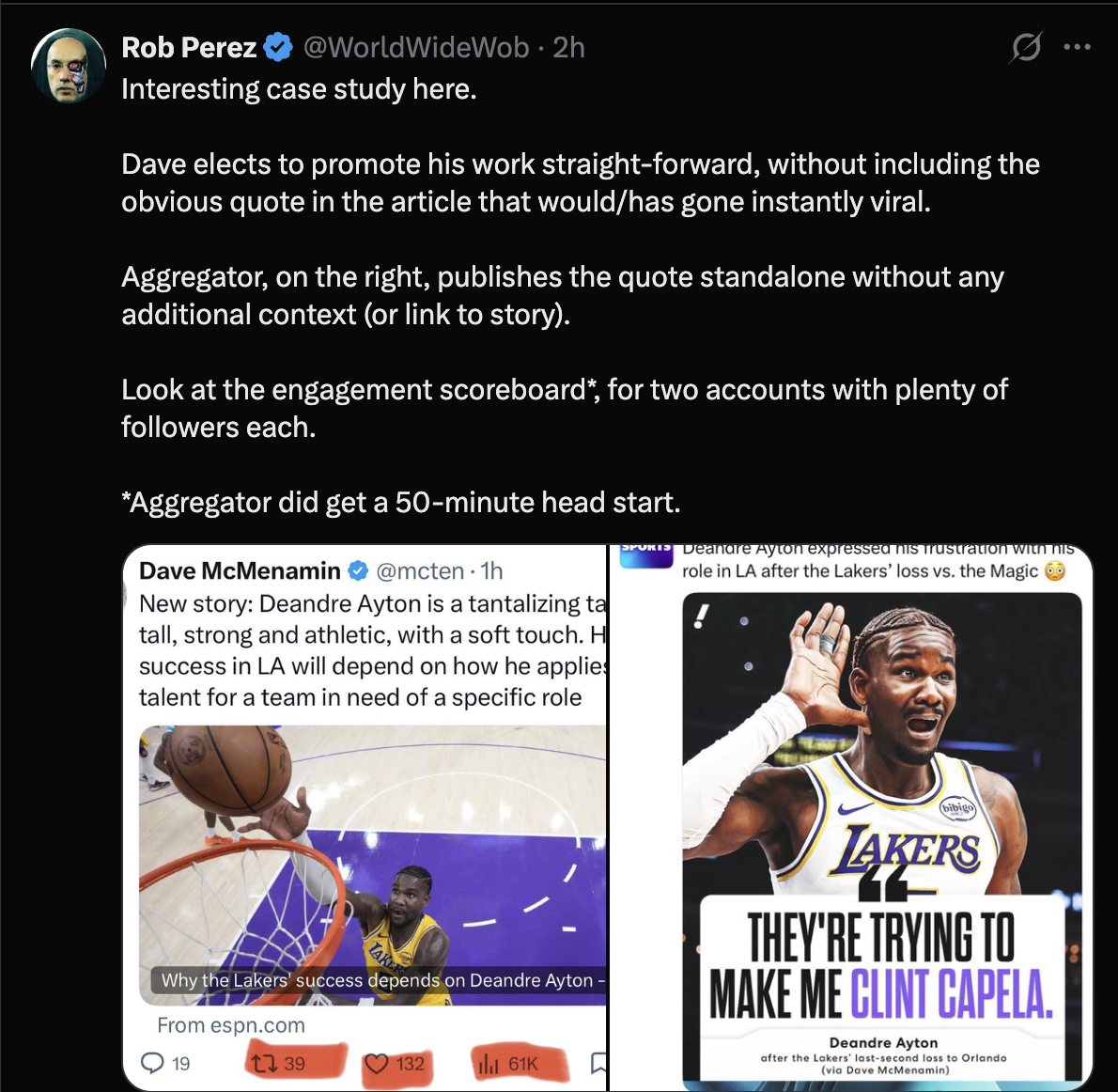
Post AI, we still have the shady network of aggregators floating around stealing and profiting off the work of the Maker. But now, we also have AI agents who can take any piece of “content” and create endless versions, post them, record the results, and adjust. In the future, that reporter could give his story to AI to create endless posts and graphics. You can see this on LinkedIn as AI comments, posts, and direct messages are rampant. An AI can comment on more things than you ever could, even if you think that is a good distribution channel.
There is no “taste” or creativity in finding a distribution edge in algorithmically powered distribution. It’s a matter of information asymmetry and brute force. The AI will find it before you ever do. This is Mover work and you should work to automate it. (I’m reminded of the scourge of AI-created music to flood Spotify.)
Now, this is not to say being strategic about distribution is not worth your time. But it’s better to focus on the paths and channels that an AI can’t outrun you. Anything where an algorithm can serve as an intermediate is a good thing to outsource to an AI. Focus on the other stuff.
Or better yet, don’t be dependent on the platforms to build your audience.
-
Using 2025 dollars: In 2012 the median photographer’s wage was $39,708. In 2022? $43,923. Interestingly, the bottom 25% of photographers saw the biggest wage growth. (via BLS.) ↩
-
For example, for a client I was tasked with producing what was effectively an online book. It was a microsite with 10+ busy CEOs as sources.
The AI could transcribe, tag quotes, and as I was writing it would recommend quotes to include and videos to produce. It could do research to make sure I covered new ground when interviewing. It would also connect dots I missed. This system still needs human intervention (taste and intuition still matter!) but I no longer have a need for “Mover” jobs like researcher, “content ops” or content designer. I owned the entire creative stack.
In the big picture, I am doing the same content writer “job” as a peer who doesn’t use this approach. But the tasks that make up the job have been expanded. Now, I need to write, research, and build AI workflows. ↩
-
This incentive structure is terrible for the Makers and for thoughtful posting, and I wish X.com had different dynamics. Alas. ↩