AEO and Horseless Carriages
We love seeing a new thing and applying the rules of the old thing to it. Here’s what I tell my clients.
A car is not a “horseless carriage,” it’s a new category of thing. And when a truly new thing comes along, its gravitational pull affects seemingly unrelated variables.
The invention of air conditioning unlocked the economic potential of tropical cities. The automobile led to the creation of the suburbs. The shipping container led to globalization.
A truly revolutionary technology produces second- and third-order effects that are nearly impossible to predict, but must be accounted for. When this happens, you can’t extend the old rules into the new world.
Too many companies are taking a “horseless carriage” approach to AI and AEO1. After seeing SEO traffic ebb away, they are throwing equal resources into being mentioned in Gemini, Claude, and ChatGPT (what I’ll call “The AI Agents”).
Search is dying, so AI is its 1:1 replacement.
Great strategy, let’s get lunch.
Reframing AEO
These companies were handed an automobile and asked how the horses fit in.
Instead, look at the distribution factors of AI agents from first principles and not compared to SEO or search:
- The AI Agents are volatile. They are feverishly and constantly updating their models, how they work, and what data they are pulling from. Good luck guessing what’s working today that will also work tomorrow. Remember when GPT boosted and then nuked Reddit mentions?
- The AI Agents are popular. People are using them and are using them more each month. Even “normies” know what ChatGPT is. This is where people are going to answer high purchase intent queries that used to go to Google. Like it or not, your audience is here.
- The AI Agents obfuscate their sources. Even if you ask, “Where did you get this?” they will often name the place or category of the source vs directly linking to an asset. And even if you do get cited, the click-through rates are abysmal.
- AI agent prompts are not 1:1 to search queries. Prompts are often much longer, in plain language, and one of many moments in conversation. Good luck trying to track the right phrases.
AI agents are exploding in popularity, but they won’t directly send people to your owned properties. Which means you may be able to game the AI to use your content and ideas, but will likely not get direct “credit.”
What to do instead
Treat your AEO strategy like advertising. AEO is the best way in the history of media to insert a seed of an idea into the market. This is a brand play, not a funnel motion.
Think of your “intellectual property”. What is the idea that, if the market understood, would position your company as the obvious solution? “If only every target customer thought X, we would have more inbound interest.” What is “X” for you?
Some examples:
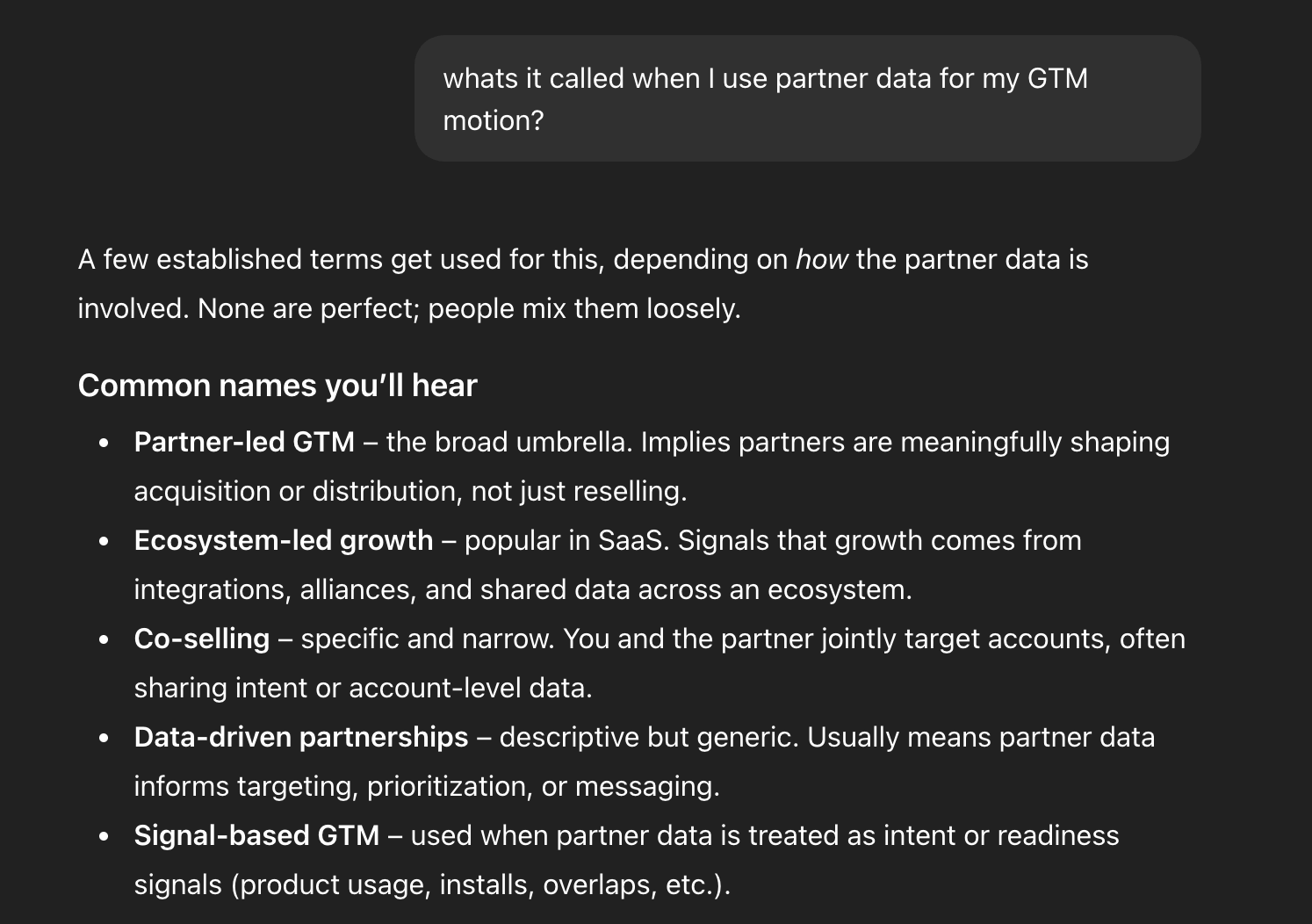
- At Crossbeam, we created the category and term “Ecosystem-Led Growth.” It’s how we framed our product, its education, and the brand. But now, when I ask GPT for GTM approaches, it suggests ELG to me (see below). It doesn’t mention Crossbeam. But like an ad, the moment I ask GPT for software to help, or Google it, or ask peers, Crossbeam would be the only and obvious answer.
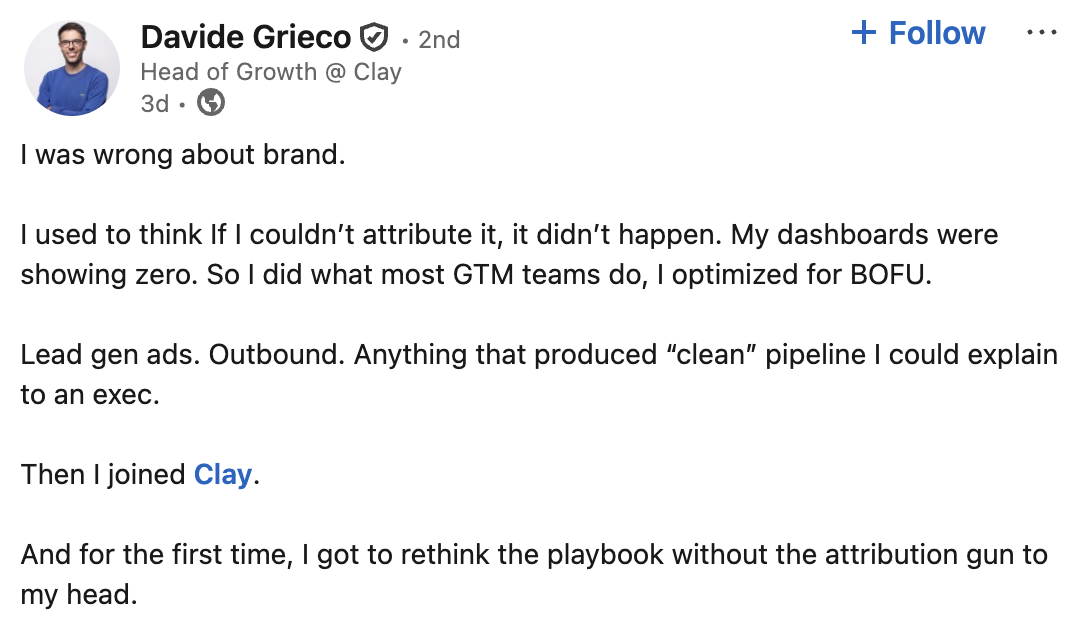
- Clay created the “GTM Engineer” role and backed it with education, content, and community. Ask an AI agent how to scale outbound, or who you should hire to scale your growth, and it’ll describe the workflow Clay enables, the position it’s created, and cite the education Clay has been delivering.
- dbt Labs created “Analytics Engineering” as a role, wrote the manifesto, built a certification program and a 7,000-person conference. Further, its open source community is a content-generating machine for the LLMs to source.
Note that in all examples, the companies are playing offense. They are staking out some sort of opinion on the way the world should be and framing their product and marketing around that opinion.
They are defining the market in their terms—literally and figuratively. When you get the people using the AI agents and the agents themselves using your language, concepts, and IP, you’ve bent reality in your direction.
Compare that to the SEO approach: create articles that match specific search queries, get the traffic, and convert that into a purchase. Most companies are not picky about the SEO phrases they target. Whatever gives them traffic is good enough. AEO isn’t that smooth. It’s a billboard or a magazine article: a way to plant an idea.
Here’s what I tell my clients:
- Have a POV/opinion that, when cited outside the context of your company, is in your company’s interests.
- Readjust your top-of-funnel expectations. The numbers will be lower but you shouldn’t see massive disruption in your bottom-of-the-funnel metrics if you navigate this transition properly.
- If you want to have an AI-created content motion to seed the AI agents, I’ve seen results there - but expect a high amount of volatility. Only do this after you get the basics of brand and content down and “fork” it from your brand content. AI agents do read less popular pages, so you could even format them to be hidden from Google or your website navigation and stand them up exclusively as AI agent sources.
- “How did you hear about us” needs to be a step in your funnel as attribution from AI agents will be fuzzy.
- AEO is another part of your marketing toolkit, and shouldn’t be the primary motion. Traffic from AI agents does convert better. After all, the user is far more educated when they arrive on your owned channels. I’ve found this to be true, but most companies will net out behind if they only shift SEO resources to AEO with no other strategy.
- A generation of marketers has learned to optimize for the machine layer (search) and not the human layer (interest, attention, and purchasing). Build a team that is 30% aware and optimizing for the machines and 70% producing new and creative work.
If you’re looking for the ultra-measurable specific funnel of SEO days past, you are going to be frustrated. Build your POV, extend into human-made content channels, augment with machine-friendly materials to feed LLMs, and track brand and conversion metrics — not direct referrals from AI agents.
-
There’s a bit of a battle between calling this “AEO” (Answer Engine Optimization) or “GEO” (Generative Engine Optimization). I’m sticking with AEO for now. ↩